
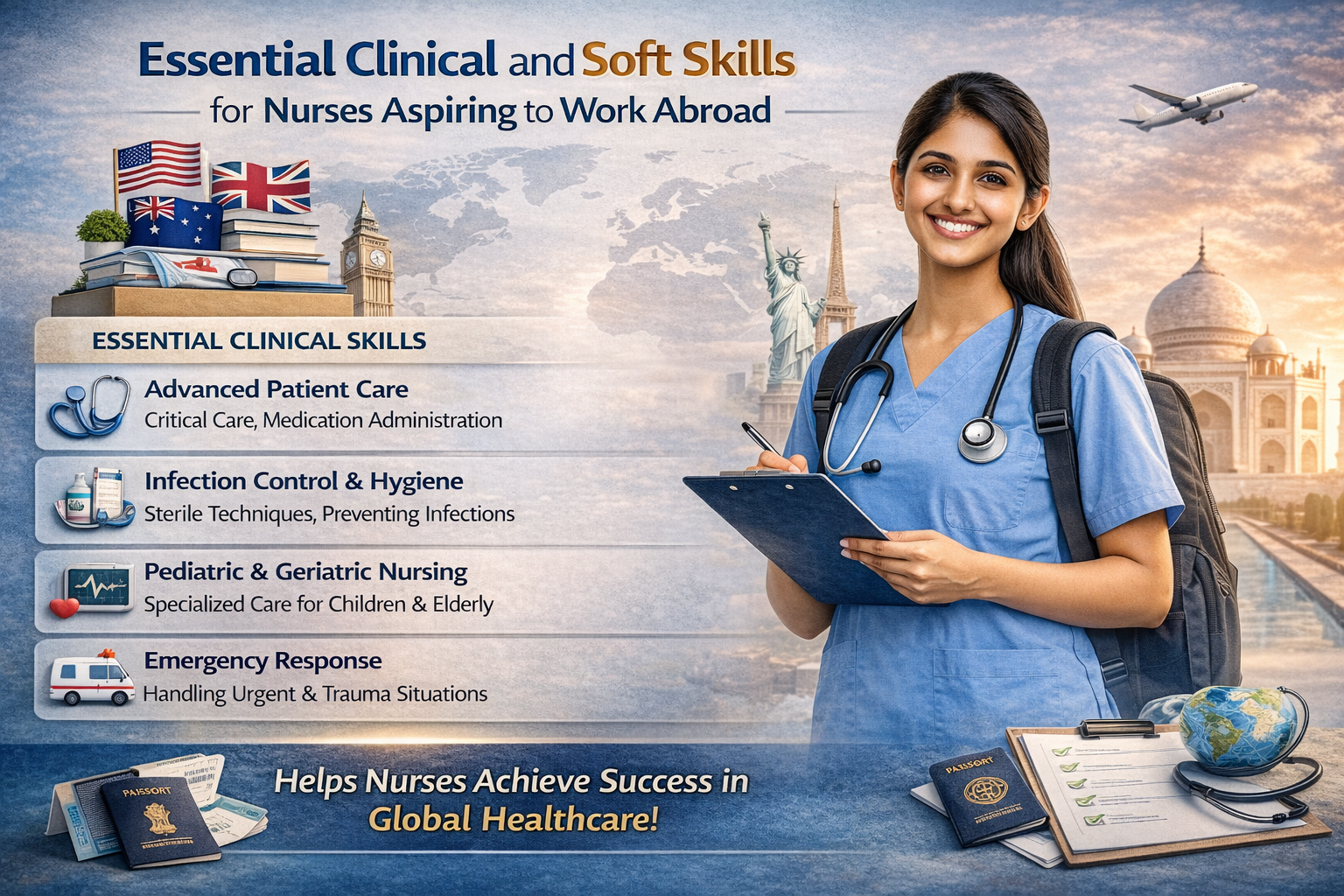
The demand for international nursing professionals is growing rapidly across the world. Countries such as the Canada, Australia are actively recruiting qualified nurses to address increasing healthcare needs. For nurses who aspire to build a global nursing career, having the right combination of clinical expertise and soft skills is essential.
Working abroad requires more than just medical knowledge. Nurses must be able to adapt to international healthcare standards, communicate effectively with patients from different cultures, and handle high-pressure environments with confidence.
In this blog, we explore the essential clinical and soft skills for nurses aspiring to work abroad and how developing these skills can open doors to rewarding global opportunities.
Strong Clinical Knowledge and Patient Care Skills
One of the most important requirements for nurses seeking international opportunities is strong clinical competence. Healthcare employers abroad look for professionals who are well-trained in patient assessment, medication administration, infection control, and emergency care.
Nurses must also be comfortable working with modern medical technologies, electronic health records (EHR), and advanced medical equipment. A strong understanding of evidence-based nursing practices ensures that patient care meets international healthcare standards.
Clinical confidence allows nurses to deliver safe, efficient, and high-quality patient care, which is a top priority in global healthcare systems.
Effective Communication Skills
Communication skills for nurses play a critical role in ensuring patient safety and healthcare coordination. Nurses working abroad must communicate clearly with patients, doctors, healthcare teams, and family members.
Most international healthcare systems require nurses to demonstrate strong English language proficiency, often proven through exams like IELTS or OET. Beyond language skills, nurses should also develop the ability to explain medical procedures, listen carefully to patient concerns, and provide clear health instructions.
Strong communication improves patient satisfaction, teamwork, and clinical outcomes, making it a key skill for international nursing professionals.
Cultural Competence and Adaptability
Healthcare systems abroad serve diverse and multicultural populations. Nurses must therefore develop cultural competence, which means understanding and respecting different beliefs, traditions, and healthcare expectations.
Being culturally sensitive helps nurses build trust with patients and provide more personalized care. Adaptability is equally important because nurses working abroad must adjust to new healthcare policies, hospital protocols, and workplace cultures.
Nurses who demonstrate flexibility and cultural awareness are more likely to succeed in international healthcare environments.
Critical Thinking and Decision-Making Skills
Another essential skill for nurses aiming to work abroad is critical thinking. In fast-paced healthcare environments, nurses often need to assess patient conditions quickly and make informed decisions.
Strong clinical judgment and problem-solving abilities enable nurses to respond effectively to emergencies, prioritize patient care, and support doctors during complex procedures.
Healthcare employers value nurses who can analyze situations, identify risks, and take appropriate action while maintaining patient safety at all times.
Teamwork and Collaboration
Healthcare delivery relies heavily on multidisciplinary teamwork. Nurses must collaborate with physicians, therapists, pharmacists, and other healthcare professionals to provide comprehensive patient care.
Strong teamwork skills help improve workflow efficiency, patient outcomes, and workplace harmony. Nurses working abroad must be comfortable working in diverse healthcare teams, often with colleagues from different countries and cultural backgrounds.
Being supportive, respectful, and cooperative makes nurses valuable members of any international healthcare team.
Emotional Intelligence and Compassion
Nursing is not only a technical profession but also a people-centered career. Nurses frequently care for patients who are experiencing pain, stress, or emotional distress.
Having strong emotional intelligence allows nurses to manage their own emotions while understanding and supporting patients. Compassionate care improves patient trust, comfort, and recovery outcomes.
Healthcare employers worldwide appreciate nurses who combine clinical efficiency with empathy and kindness.
Time Management and Organizational Skills
Working in hospitals and healthcare facilities requires excellent time management skills. Nurses often handle multiple patients, administer medications, update medical records, and assist doctors simultaneously.
Good organizational skills help nurses prioritize tasks, manage workload efficiently, and maintain accuracy in medical documentation.
International healthcare systems especially value nurses who can work efficiently under pressure while maintaining high standards of patient care.
Commitment to Continuous Professional Development
To work abroad, nurses must often meet international licensing requirements such as NCLEX, CBT, OSCE, or bridging programs. This means nurses must stay committed to continuous learning and professional development.
Keeping up with global nursing standards, medical advancements, and clinical training programs helps nurses remain competitive in the international job market.
A commitment to lifelong learning demonstrates professional dedication and career growth potential, which healthcare employers highly value.
Leave A Comment