
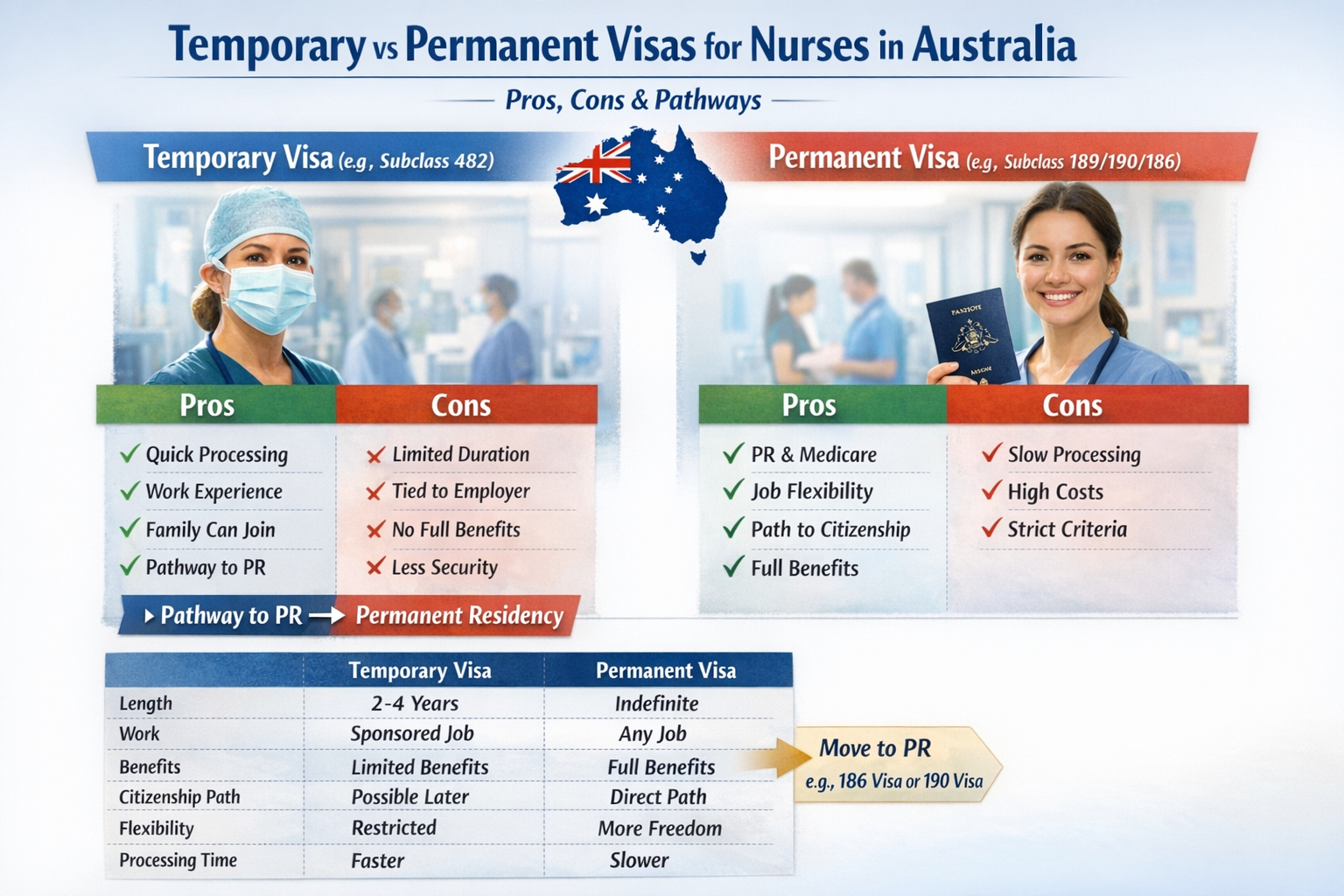
Australia continues to be one of the top destinations for international healthcare professionals. With a strong demand for skilled nurses across hospitals, aged care facilities, and regional health centers, the country offers multiple visa pathways.
If you are planning to work as a nurse in Australia, understanding the difference between temporary and permanent visas is essential for making the right career decision.
In this guide, we compare visa options, highlight their pros and cons, and explain the most common immigration pathways available for nurses.
Why Australia Needs Skilled Nurses
Australia’s healthcare sector faces ongoing workforce shortages due to:
- Aging population
- Expansion of healthcare services
- Regional and rural demand
- Retirement of experienced nurses
This has created excellent migration opportunities for internationally qualified nurses.
Temporary Visas for Nurses in Australia
Temporary visas allow nurses to live and work in Australia for a limited period. They are often used as a stepping stone toward permanent residency.
1. Temporary Skill Shortage Visa (Subclass 482)
The Temporary Skill Shortage (TSS) visa allows Australian employers to sponsor overseas nurses to fill workforce gaps.
Pros:
- Faster processing compared to PR
- Employer-sponsored job security
- Pathway to permanent residency in many cases
- Allows family members to accompany you
Cons:
- Dependent on employer sponsorship
- Limited duration (usually 2–4 years)
- Changing employers requires new sponsorship
- Less flexibility compared to PR
Best For:
Nurses who have secured a job offer from an Australian employer and want a quicker entry route.
2. Working Holiday Visa (Limited for Some Nurses)
In certain cases, eligible applicants from specific countries may work in healthcare roles under working holiday arrangements.
Pros:
- Easy entry
- Opportunity to explore Australia
- Short-term work flexibility
Cons:
- Not a long-term solution
- Limited healthcare registration eligibility
- No direct pathway to permanent residency
Permanent Visas for Nurses in Australia
Permanent visas allow nurses to live, work, and settle in Australia indefinitely. They offer long-term stability and additional benefits.
1. Skilled Independent Visa (Subclass 189)
This is a points-tested visa that does not require employer sponsorship.
Pros:
- Full permanent residency
- No employer restrictions
- Freedom to live and work anywhere in Australia
- Access to Medicare and social benefits
Cons:
- Highly competitive points system
- Longer processing times
- Requires strong English scores and skills assessment
Best For:
Highly qualified nurses with competitive points and independent migration goals.
2. Skilled Nominated Visa (Subclass 190)
This visa requires nomination by an Australian state or territory government.
Pros:
- Permanent residency
- Additional points for state nomination
- High demand in regional areas
- Access to public healthcare benefits
Cons:
- Must commit to living in the nominating state
- Occupation must be on state occupation list
3. Employer Nomination Scheme (Subclass 186)
This visa allows employers to sponsor nurses directly for permanent residency.
Pros:
- Direct PR pathway
- Employer support
- Stable long-term employment
Cons:
- Tied to employer during nomination process
- Strict eligibility criteria
Key Differences: Temporary vs Permanent Visa for Nurses
| Feature | Temporary Visa | Permanent Visa |
|---|---|---|
| Duration | 2–4 years | Indefinite |
| Employer Dependency | Yes (mostly) | No (for 189/190) |
| Medicare Access | Limited | Full access |
| Job Flexibility | Restricted | Full freedom |
| PR Status | No | Yes |
| Family Benefits | Limited | Full benefits |
Which Visa Pathway is Right for You?
Choosing between temporary and permanent visas depends on:
- Your career goals
- English proficiency
- Points score
- Employer sponsorship availability
- Long-term settlement plans
Many nurses start with a temporary visa (Subclass 482) and later transition to permanent residency through Subclass 186 or other skilled migration pathways.
Registration Requirements for Nurses
Before applying for any visa, nurses must:
- Obtain skills assessment
- Meet English language requirements (IELTS/OET)
- Register with the Nursing and Midwifery Board of Australia (NMBA)
- Be assessed through AHPRA
Without proper registration, visa approval alone does not allow you to practice.
Regional Opportunities for Nurses
Australia strongly encourages nurses to work in regional and rural areas. State governments frequently prioritize healthcare professionals in their occupation lists, improving PR chances under Subclass 190 and regional migration programs.
Leave A Comment